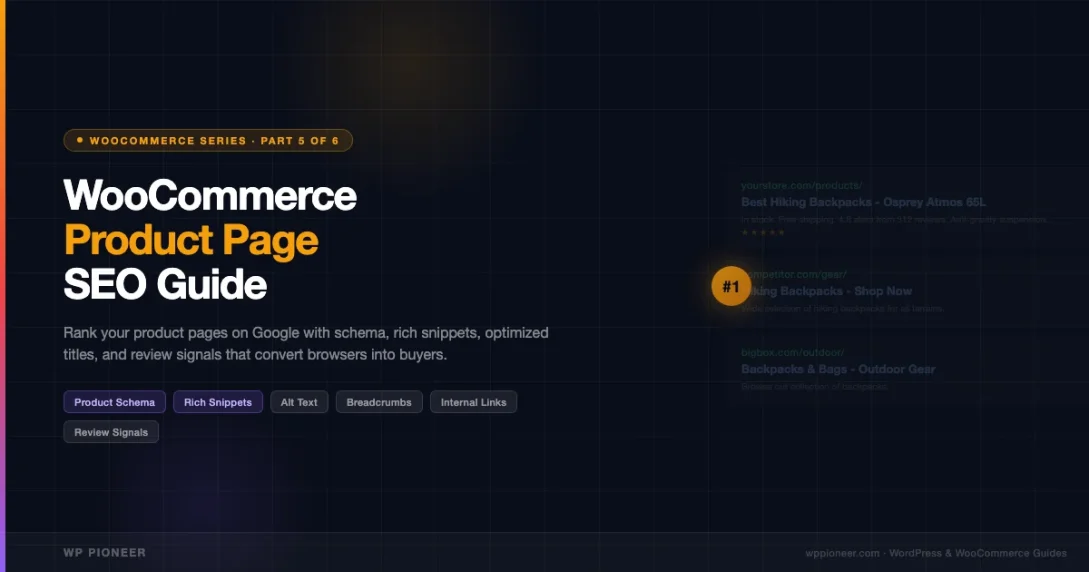
Your WooCommerce store could have the best products in your niche, but if your product pages don’t rank on Google, you’re invisible to buyers who are ready to purchase. WooCommerce product page SEO isn’t a one-time checklist, it’s a system of interlocking signals that tells Google exactly what each product is, who it’s for, and why it deserves a top-three position for commercial search terms. This guide covers every lever you can pull: product titles, descriptions, schema markup, image optimization, review signals, internal linking, and breadcrumb navigation. Follow it end to end and you’ll have product pages built to rank and convert.
Why WooCommerce Product Page SEO Is Different from Blog SEO
Blog posts chase informational queries (“how to choose running shoes”). Product pages chase transactional and commercial queries (“buy trail running shoes size 10” or “best lightweight trail running shoes under $100”). The user intent is completely different, which means the optimization rules are different too.
Google’s Quality Rater Guidelines treat product pages as YMYL (Your Money or Your Life) content. They apply heightened scrutiny around trust signals: reviews, accurate pricing, clear policies, and authoritative product information. A product page that’s thin on content, lacks structured data, or shows no social proof will struggle to outrank established competitors even if you nail the keyword placement.
There’s also the architecture challenge. A typical WooCommerce store generates dozens or hundreds of very similar URLs, product pages, category pages, tag archives, sorting/filter parameters, and without deliberate SEO control you’ll create massive duplicate content problems that cannibalize rankings and dilute crawl budget.
Product page SEO is where most WooCommerce stores leave money on the table. Getting the fundamentals right, title, description, schema, images, is worth more than any link-building campaign you could run.
Optimizing WooCommerce Product Titles for Search and Clicks
The product title is the highest-weight on-page signal on your product page. It feeds Google’s <title> tag, the H1 heading, and the URL slug simultaneously, making it the single most important field you’ll fill out for any product.
The Anatomy of a High-Ranking Product Title
A well-structured product title for WooCommerce SEO typically follows this pattern: [Brand] + [Primary Keyword] + [Key Differentiator] + [Model/SKU if relevant].
| Element | Example | SEO Purpose |
|---|---|---|
| Brand name | Osprey | Trust signal, branded search |
| Primary keyword | Hiking Backpack 65L | Core ranking target |
| Differentiator | Lightweight Framesheet | Long-tail variation targeting |
| Gender/size | Men’s | Segment-specific queries |
| Color | Forest Green | Variation-level search intent |
Avoid vanity words in product titles. Words like “amazing,” “premium,” “best,” and “affordable” add no ranking value. Google ignores them, and real buyers looking at 10 results in a SERP have learned to ignore them too. Use the title characters for informational density: capacity, material, compatibility, key features.
Title Length and the SEO Title vs. Product Name
WooCommerce uses the product name as both the H1 and the default SEO title. If your product name is long and descriptive, that’s fine for the H1, but the SEO title (the one appearing in SERPs) should be kept under 60 characters to avoid truncation. With RankMath or Yoast installed, you can set a shorter, punchier SEO title while keeping the full descriptive product name on the page itself.
For variable products, avoid putting variation attributes (color, size) in the parent product name. Handle them at the variation level. The parent page should target the broadest commercial query for that product family, and individual variation URLs, if you allow them to be indexed, can target more specific queries.
Writing Product Descriptions That Rank and Convert
WooCommerce gives you two description fields: the main product description (below the Add to Cart button) and the short description (the snippet shown next to the product image in the summary area). Both play important roles in SEO and conversion, but they serve different purposes.
The Short Description: Your 40-Word Pitch
The short description appears prominently above the fold and is often what Google pulls into rich snippets. Treat it as your elevator pitch: what is this product, who is it for, and what’s the one thing that makes it worth buying? Keep it to two or three sentences, lead with the primary keyword, and make every word count.
Bad short description: “This is a fantastic product that our customers love. Made from high-quality materials, it’s sure to impress everyone who uses it.”
Good short description: “The Osprey Atmos 65L is a 65-liter hiking backpack with an anti-gravity suspension system built for multi-day trails. Fits torso lengths 16–21 inches. Available in men’s and women’s specific versions.”
The second version tells Google what the product is, hits key search terms naturally (hiking backpack, 65L, anti-gravity suspension, multi-day), and gives a buyer the information they need to assess fit without scrolling.
The Main Description: Where You Win the Long Tail
The main product description is your best opportunity to rank for long-tail queries, address pre-purchase objections, and demonstrate the depth of knowledge that Google’s algorithms associate with authoritative product pages. Don’t treat it as a place to dump a manufacturer’s spec sheet.
Effective main descriptions do all of the following:
- Address the buyer’s primary concern, what problem does this product solve and how?
- Use semantic keyword variations naturally, if your target keyword is “woocommerce product page seo,” related terms like “product schema,” “meta description,” “structured data,” and “search rankings” should appear naturally in the copy
- Answer FAQs inline, questions like “Is this waterproof?” or “Will this fit in carry-on luggage?” often mirror exactly what people type into Google
- Include specific measurements, materials, and compatibility information, precision builds trust and captures specification-based searches
- Use heading structure (H3/H4) for long descriptions, Google parses headings to understand topical structure within the page
Target a minimum of 300 words for product descriptions on competitive-category products. For flagship or hero products competing in saturated niches, 600–800 words is not unusual and is often necessary to outrank big-box retailers who invest heavily in product content.
Keyword Research for Product Descriptions
Before writing a product description, run keyword research specifically for transactional intent. Tools like Google’s Search Console (for existing products), Ahrefs, and Semrush’s Keyword Magic Tool will show you what buying-intent queries your product type attracts. If you’re just starting out with WordPress SEO basics, build that foundation first before diving into product-specific optimizations. Look for patterns like:
- “[product name] review”, informational, but creates ranking opportunities for your own page
- “best [product category] for [use case]”, commercial investigation queries
- “[product name] vs [competitor product]”, high-intent comparison queries
- “[product name] [key spec]”, specification-driven search (e.g., “trail shoes drop 4mm”)
- “where to buy [product name]”, direct purchase intent
Work these phrases into your product description organically. The goal is not keyword stuffing, it’s demonstrating to Google that your page genuinely covers everything a buyer might want to know about this product.
Product Schema Markup: Telling Google What Your Page Is About
Structured data, specifically Product schema from Schema.org, is the single most powerful technical SEO tool available to WooCommerce stores. It lets you pass machine-readable information directly to search engines: price, availability, ratings, SKU, brand, and dozens of other attributes that Google uses to power rich results.
What Product Schema Unlocks in Google Search
When your product pages have valid, complete Product schema, Google can display enhanced results in multiple placements:
- Rich snippets, price and star rating shown directly in blue-link results
- Google Shopping tab, free product listings in the Shopping tab (merchant center free listings program)
- Google Images Shopping annotations, price badges on product images in image search
- Seller ratings in ads, if you also run Google Ads, schema ratings feed into ad extensions
- AI Overviews, Google’s AI-generated summaries increasingly pull structured product data for commercial queries
Implementing Schema in WooCommerce
The easiest implementation path for most WooCommerce stores is via RankMath or Yoast SEO Premium, both of which auto-generate Product schema from WooCommerce’s native data fields. RankMath’s WooCommerce integration is particularly thorough, it pulls price, availability, SKU, ratings, brand (from product attributes), and GTIN/MPN if you’ve populated those fields.
The critical schema fields for ranking and rich results are:
| Schema Property | Source in WooCommerce | Rich Result Impact |
|---|---|---|
| name | Product title | Headline in rich snippet |
| description | Short description | Snippet body text |
| image | Featured product image | Thumbnail in Shopping tab |
| offers.price | Product price | Price shown in SERP |
| offers.availability | Stock status | In Stock / Out of Stock badge |
| aggregateRating | WooCommerce reviews | Star rating in rich snippet |
| brand | Product attribute or custom field | Brand filter in Shopping tab |
| gtin / mpn / sku | Product SKU field | Product identity/deduplication |
The offers.availability field is especially important: Google won’t display price-rich snippets for pages where availability is missing or invalid. Set it to https://schema.org/InStock for available products and keep it updated, Google crawls product pages frequently and will penalize schemas with stale availability data.
Validating Your Schema
Use Google’s Rich Results Test (search.google.com/test/rich-results) and Schema.org’s validator to check your output. Common WooCommerce schema errors include: missing offers nesting, invalid currency codes, and aggregateRating values below Google’s minimum review count threshold (typically one review). Fix all errors before expecting rich results to appear, partial or invalid schema is worse than no schema because it wastes your crawl budget on structured data that delivers nothing.
WooCommerce Product Image Optimization for SEO
Product images are an underrated SEO lever. Google Images drives significant traffic for product searches, and your product images appear in both organic image results and Google Shopping carousels. Poor image optimization means you’re leaving those placements to competitors.
File Names: Your First On-Page Signal
Never upload product images with camera-generated file names like DSC_4821.jpg or IMG_20250112.png. Rename every image before uploading to WooCommerce using descriptive, keyword-rich, hyphenated names.
A product image for an Osprey hiking backpack should be named something like osprey-atmos-65l-hiking-backpack-forest-green.jpg, not backpack1.jpg. The file name is one of the signals Google uses to understand what’s in the image before it reads the alt text.
Alt Text: The Most Important Image SEO Field
Alt text (the alt attribute on the <img> tag) serves two purposes: accessibility for screen readers and SEO for search engines. For product images, write alt text that describes the image accurately while naturally including your target keyword.
For a main product image: “Osprey Atmos 65L hiking backpack in forest green, front view showing anti-gravity suspension frame”
For a lifestyle/context image: “Hiker wearing Osprey Atmos 65L backpack on rocky mountain trail, showing pack fit and load distribution”
Don’t write the same alt text for every image on the product page, each image should have unique, descriptive alt text that targets different aspects of the product and different search queries.
Image Format, Size, and Core Web Vitals
Page speed is a ranking factor, and large unoptimized product images are one of the most common causes of failing Core Web Vitals scores on WooCommerce stores. Google measures Largest Contentful Paint (LCP), typically the main product image, as a key performance signal.
Best practice for WooCommerce product images:
- Format: Use WebP for all product images. WooCommerce with the Imagify, ShortPixel, or Smush plugin will auto-convert on upload. WebP is 25–35% smaller than JPEG at equivalent quality.
- Size: Upload images at the largest size you’ll display them (typically 800–1200px on the longest edge). WooCommerce generates its own thumbnails from whatever you upload, don’t upload a 4000px image when your product images display at 600px.
- Compression: Target 80–85% quality for WebP. The file size savings at this level are substantial with virtually no visible quality loss.
- Lazy loading: WooCommerce adds
loading="lazy"to gallery images by default in recent versions. Ensure the main featured product image does NOT have lazy loading, it needs to load immediately for LCP.
Multiple Product Images and Image Sitemaps
Use multiple product images showing different angles, context shots, packaging, and scale references. Google indexes all images on a product page, and each image is an additional entry point from Google Images. An image sitemap (auto-generated by Yoast and RankMath) helps Google discover and index all your product images, without it, images in JavaScript-rendered galleries may not be crawled.
Customer Reviews: The SEO Signal Most Stores Underuse
Customer reviews are one of the most powerful and most underutilized SEO tools for WooCommerce product pages. They work on multiple levels simultaneously: fresh user-generated content that keeps your pages crawl-worthy, natural language that captures long-tail queries you’d never think to target yourself, and social proof that improves conversion rates (which improves engagement signals, which helps rankings).
How Reviews Influence Rankings Directly
When a customer writes “I’ve been using these trail running shoes on technical mountain terrain for six months and the grip on wet rock is exceptional,” they’ve just added highly specific, long-tail content to your product page that targets queries like “trail running shoes grip wet rock” and “trail running shoes technical terrain”, queries you probably didn’t write for. Reviews are essentially free, continuous, user-generated keyword research and content creation.
Beyond content, the aggregateRating in your Product schema draws directly from WooCommerce reviews. A product with 4.7 stars from 43 reviews gets a rich snippet star rating in Google Search. A product with no reviews gets none. The click-through rate difference between a result showing stars and one that doesn’t can be 30–40%, a massive organic traffic multiplier that costs you nothing once the review pipeline is running.
Getting More Reviews
WooCommerce’s built-in review system is functional but passive, customers have to remember to come back and leave a review. Active review collection strategies significantly outperform passive defaults:
- Post-purchase email sequence: Send a review request email 7–14 days after estimated delivery. Plugins like AutomateWoo and Klaviyo make this easy to automate with WooCommerce order data.
- Verified purchase badge: Enable WooCommerce’s “Review must be from a verified purchase” setting. Verified reviews carry more weight with both customers and Google’s quality assessments.
- Review schema accuracy: If you import reviews from Amazon or use a third-party platform, ensure your schema accurately reflects only reviews submitted on your site, cross-site review aggregation violates Google’s guidelines.
- Respond to negative reviews: Responding professionally to negative reviews signals active merchant engagement, a positive trust signal for both Google and hesitant buyers.
Internal Linking Strategy for WooCommerce Product Pages
Internal links are the mechanism by which PageRank, Google’s foundational measure of page authority, flows through your site. A product page with strong internal links pointing to it will outrank an identical product page on a competitor’s site that has weaker internal linking, all else being equal. This is one of the few ranking factors you have complete control over.
Category Pages as Link Hubs
Your category pages are naturally the primary source of internal links to product pages, every product listed in a category gets a link from that category page. But most WooCommerce stores stop there. Go further:
- Blog posts linking to products: A “Best Hiking Backpacks” roundup post that links to your top-selling packs with anchor text like “Osprey Atmos 65L review” passes both link equity and click intent.
- Related products widget: WooCommerce’s native related products section is automatic, but consider replacing it with manually curated related products that create deliberate linking clusters around your most important product pages.
- Upsell and cross-sell links: The upsell panel on a product page links upward (to premium alternatives) and the cross-sell panel in the cart links laterally (to complementary products). Both create useful internal links with product-relevant anchor text.
- Homepage links to bestsellers: Your homepage is your highest-authority page. A “Featured Products” or “Bestsellers” section on the homepage directly passes homepage authority to your most important product pages.
Anchor Text for Product Internal Links
The anchor text of internal links is a direct ranking signal, Google uses it to understand what the destination page is about. For product pages, use descriptive anchor text that includes your target keyword. Instead of “click here to see our backpacks,” write “shop our full range of lightweight hiking backpacks.” The second version gives Google explicit topical context about the destination page.
Vary your anchor text across different linking pages rather than using the exact same phrase every time, over-optimized exact-match anchor text patterns can look manipulative to Google’s algorithms.
Breadcrumb Navigation: UX and SEO in One Feature
Breadcrumb navigation, the “Home > Hiking Gear > Backpacks > Osprey Atmos 65L” trail that appears near the top of a product page, is one of those SEO features that simultaneously improves user experience and sends strong structural signals to Google. When implemented with proper BreadcrumbList schema markup, breadcrumbs appear directly in Google Search results, replacing the URL path with a more readable site hierarchy. This is one of the most overlooked elements covered in any thorough WordPress SEO guide for beginners, yet it pays dividends across your entire product catalog.
Enabling WooCommerce Breadcrumbs
WooCommerce includes built-in breadcrumb functionality. Whether breadcrumbs are displayed depends on your active theme, most modern WooCommerce themes display them, but some theme frameworks suppress them or move their placement. Check your product page template and confirm breadcrumbs are visible above or below the product title.
If breadcrumbs aren’t showing or are showing incorrect category paths, the most reliable fix is to install a dedicated breadcrumb plugin (Breadcrumb NavXT is the most widely used) or to use your SEO plugin’s breadcrumb replacement feature. Both RankMath and Yoast include breadcrumb override functionality that replaces your theme’s breadcrumbs with their own implementation, and crucially, their breadcrumbs come with automatic BreadcrumbList schema output.
Breadcrumb Schema and SERP Display
The BreadcrumbList schema tells Google the exact hierarchy of your site and lets Google display that hierarchy in search results. When breadcrumb schema is valid and detected, Google replaces the green URL display with your breadcrumb labels, e.g., “wppioneer.com > Backpacks > Osprey Atmos 65L” instead of the full URL slug. This makes your result look cleaner and more navigable, and can measurably improve click-through rates by helping users understand where the page sits in your site’s context before they click.
Category Assignment Affects Breadcrumb SEO
In WooCommerce, the breadcrumb path shown on a product page follows the product’s primary category. If a product is assigned to multiple categories, the breadcrumb displays the primary category path, which you can set in the product’s Category metabox. Assign the most topically relevant, highest-authority category as primary. A product that shows a shallow breadcrumb path (“Home > Uncategorized > Product”) is a signal to both Google and users that your site’s architecture is poorly organized.
Technical SEO for WooCommerce Product Pages
Beyond on-page content, several technical factors directly impact whether your product pages rank well. These are settings you configure once but that affect the SEO health of every product page on your store.
Canonical URLs and Duplicate Content
WooCommerce product pages can generate multiple URLs for the same content. A single product might be accessible at all of the following:
example.com/product/osprey-atmos-65l/(the canonical product URL)example.com/product-category/backpacks/osprey-atmos-65l/(category-nested URL)example.com/?product=osprey-atmos-65l(query string URL)example.com/product/osprey-atmos-65l/?color=green&size=large(variation/filter URL)
All of these URLs serving the same or near-identical content creates duplicate content problems that split PageRank and confuse Google about which URL to rank. Set canonical URLs for all product pages pointing to the clean /product/slug/ format. Your SEO plugin handles canonical tags automatically if configured correctly, ensure “Canonical URL” is enabled in your plugin’s WooCommerce settings panel.
Handling Out-of-Stock and Discontinued Products
Product pages that go out of stock or get discontinued are a common source of 404 errors and ranking loss. The correct handling depends on the situation:
| Situation | Recommended Action | Why |
|---|---|---|
| Temporarily out of stock | Keep page live, update availability schema | Don’t lose rankings for a temporary stock issue |
| Seasonal product, returns next year | Keep page live, add “Back next [season]” note | Rankings built over time are hard to rebuild |
| Permanently discontinued, has successor | 301 redirect to new product | Transfer existing link equity to successor |
| Permanently discontinued, no successor | 301 redirect to category page | Preserve crawl flow, avoid 404s |
| Discontinued, high backlink value | Keep page live with alternative suggestions | Preserve backlink equity, convert visitors |
URL Structure and Slugs
WooCommerce product slugs default to the full product name, which often produces bloated, keyword-stuffed URLs. Trim product slugs to include only the most important descriptive terms. “osprey-atmos-65l-hiking-backpack-anti-gravity-suspension-framesheet-mens-forest-green” is too long, “osprey-atmos-65l” or “osprey-atmos-65l-hiking-backpack” is more appropriate.
Critically: once a product page is indexed and ranking, never change its slug. A slug change creates a new URL, killing any rankings built up on the old one. If you must change a slug on a live ranking page, implement a 301 redirect immediately and update all internal links. Our guide to setting up SEO-friendly WordPress permalink structures explains how WP handles redirects and URL changes across the entire site.
Page Speed and Core Web Vitals
WooCommerce product pages are notoriously heavy. A typical product page loads WooCommerce JavaScript for the add-to-cart system, variation switching, image gallery, and quantity adjustments, plus whatever your theme and plugins add. Use GTmetrix or Google PageSpeed Insights to audit your product pages specifically (not just your homepage, product pages often score differently).
The highest-impact optimizations for WooCommerce product page speed are: caching (WP Rocket or LiteSpeed Cache), a CDN for images and static assets (Cloudflare is free), image compression (WebP conversion via Imagify or ShortPixel), and lazy loading for gallery images. Combined, these can take a typical WooCommerce product page from a 4-second load to under 2 seconds, a threshold that meaningfully improves both Google rankings and conversion rates.
WooCommerce Category Pages: The Tier Above Products
Category pages are often where the highest-volume, most competitive queries land. “Hiking backpacks” is a category-level query. “Osprey Atmos 65L review” is a product-level query. Category pages rank for the broad terms; product pages rank for the specific ones. Both need dedicated SEO attention.
Adding SEO Content to Category Pages
By default, WooCommerce category pages show a grid of products with no text content, just thumbnails, product names, prices, and an Add to Cart button. This minimal content gives Google almost nothing to rank the page on beyond the category name itself.
Add a category description block (200–400 words) at the top or bottom of each primary category page. WooCommerce has a built-in category description field. Fill it with content that contextualizes the category, what products are in it, who they’re for, what buying criteria matter, and naturally incorporate the category’s target keyword. This transforms a thin product grid into a content-rich landing page that can compete for high-volume category queries.
Category Page Schema
Category pages should have CollectionPage or ItemList schema marking them as curated lists of products. This signals to Google that the page is an authoritative overview of a product type, exactly what searchers looking for category-level queries need. RankMath supports CollectionPage schema for WooCommerce categories natively.
Measuring WooCommerce Product Page SEO Performance
You can’t improve what you don’t measure. Set up tracking systems that show you which product pages are gaining and losing rankings, where traffic is coming from, and which optimizations are actually moving the needle.
Google Search Console for Product Pages
Google Search Console is the most authoritative source of product page SEO data, it shows you exactly which queries are generating impressions and clicks for each of your product URLs, their average position, and their click-through rate. Use the URL Inspection tool to submit new or updated product pages for indexing. The Performance report filtered by “Pages” will show you which products are ranking and which are invisible.
The position gap report is particularly valuable for WooCommerce: look for product pages ranking at positions 5–20 for their target queries. These pages have already demonstrated relevance to Google, a focused optimization pass (improving description depth, adding missing schema fields, building a few internal links) can push them into the top three where they’ll generate dramatically more clicks.
Tracking Schema and Rich Result Status
Search Console’s “Enhancements” section shows the status of your structured data. Check the “Products” report regularly, it shows which pages have valid schema, which have warnings, and which have errors that are preventing rich results. A single missing required field (commonly offers.price or offers.availability) across thousands of products can be blocking your entire store from displaying star ratings in search results.
A WooCommerce Product Page SEO Checklist
Use this checklist when creating new products or auditing existing ones:
- Product title contains primary keyword in natural position
- SEO title is under 60 characters (set separately via RankMath/Yoast)
- Meta description is under 160 characters, includes primary keyword, and has a clear value proposition
- Short description (2–3 sentences) leads with keyword, describes product succinctly
- Main description is 300+ words, uses semantic keyword variations, answers common buyer questions
- Product schema is valid: price, availability, rating, brand, and SKU are all populated
- All product images have descriptive file names (hyphenated, keyword-rich)
- All product images have unique, descriptive alt text
- Main product image is in WebP format and under 100KB
- Product is assigned to the correct primary category (check breadcrumb path)
- Product has at least one published customer review (enables aggregateRating schema)
- At least two internal links point to this product from related content
- Breadcrumbs are visible and showing correct category hierarchy
- Canonical URL is set to the clean product URL
- Product URL slug is short, descriptive, and contains the primary keyword
- Core Web Vitals score for this product page is passing (check via PageSpeed Insights)
Prioritizing Your WooCommerce Product SEO Efforts
If you have hundreds or thousands of products, you can’t optimize everything at once. Start with the 20% of products that drive 80% of your revenue. Get those pages to full optimization, complete descriptions, schema, optimized images, breadcrumbs, internal links, before tackling the rest of the catalog.
Within that priority set, use Google Search Console position data to identify quick wins: products already ranking on page two (positions 11–20) for their primary keyword. A focused optimization on these pages delivers faster results than starting from scratch with unranked pages, because Google has already established topical relevance, you’re just giving the algorithm enough signal to move the page up.
The compounding nature of product page SEO is what makes it such a high-return investment. Unlike paid search where traffic stops when budget runs out, a well-optimized product page keeps ranking and generating traffic for years. Every hour spent on WooCommerce product page SEO is an investment with a long payback window.
Next in the Series
This is part five of a six-part WooCommerce SEO series. Part six covers WooCommerce technical SEO at scale, crawl budget management, international product catalogs, hreflang for multi-currency stores, and XML sitemap strategy for large stores with frequent inventory changes.
Start Ranking Your Product Pages Today
WooCommerce product page SEO is not a single task, it’s a system. Product titles and descriptions are the foundation. Schema markup unlocks rich results. Image optimization captures Google Images traffic. Reviews add fresh content and social proof. Internal links pass authority. Breadcrumbs signal site structure. Together, these elements build product pages that Google trusts enough to rank and buyers trust enough to purchase from.
Pick your five highest-revenue products and run them through the full checklist in this guide. Use Google Search Console to baseline their current rankings. In six to eight weeks, you’ll have clear data on which optimizations moved the needle, and a repeatable system you can apply across your entire catalog.
Google Search Console On-Page SEO Product Schema Markup WooCommerce Product Pages WooCommerce SEO
Last modified: April 10, 2026