
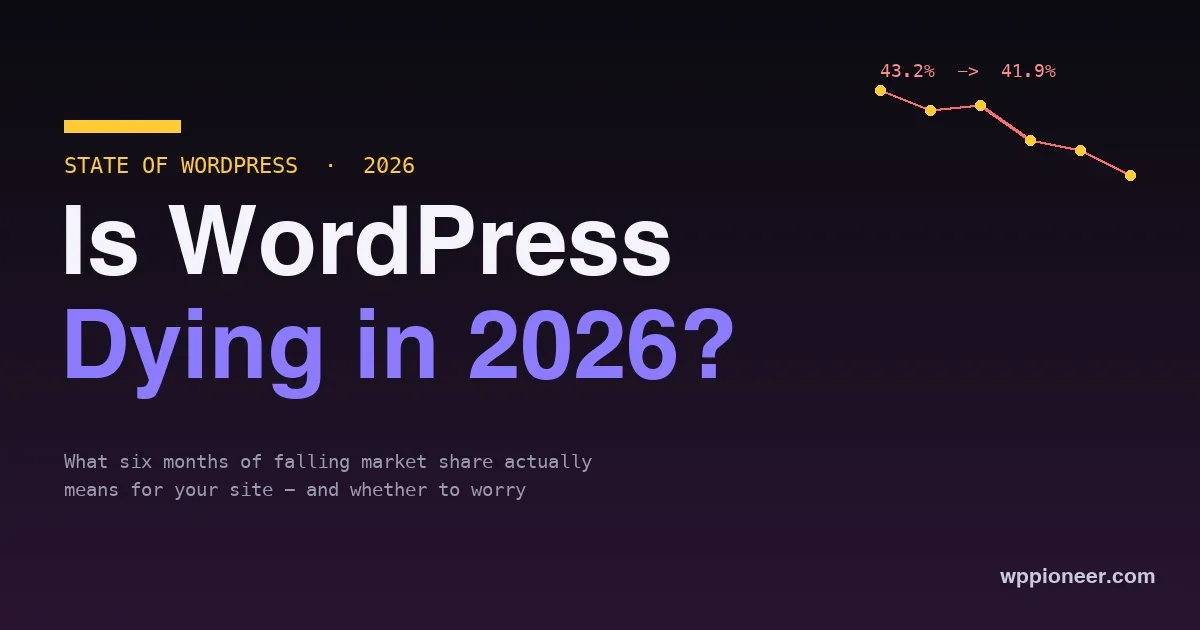
If you run a WordPress site, you may have seen the worrying headline: WordPress is losing ground. It is true that its share of the web has fallen for six straight months, from 43.2 percent at the end of 2025 to 41.9 percent by late May 2026. For a platform that seemed unstoppable, six months of decline is a real story, and it is fair to wonder whether you have built your site on something that is fading. The short answer is no, WordPress is not dying, but the longer answer is more useful, because the reasons behind the dip tell you exactly what to do about your own site.
This is a plain-English look at what the numbers actually mean, why the decline is happening, and whether a site owner should worry, switch, or simply run their site better. No hype in either direction.
The numbers, in perspective
WordPress powers about 41.9 percent of all websites. To put that in context, that is still more than four in ten sites on the entire internet, and far more than any other platform. The nearest competitors are in single digits. So the decline is real, but it is a decline from a position of total dominance to a position of very large dominance. A company losing market share from 43 percent is in a very different situation from one losing share at 5 percent. WordPress is not collapsing; it is slipping from unchallenged to merely dominant.
We have heard “WordPress is dying” before
This is not the first time the platform has been written off. When social media took off, people said blogs and WordPress were finished. When website builders like Squarespace arrived, the same obituary appeared. When the block editor replaced the classic one, plenty declared WordPress had lost its way. Each time, the platform kept growing in absolute terms and stayed the most-used way to build a site. Predictions of its death have a long and unreliable track record.
That history does not make WordPress immortal, but it is a useful check on the current headline. A mature platform losing a point of share in a growing, diversifying market is normal, not fatal. The sensible stance is neither blind loyalty nor panic, but attention: watch the trend, keep your own site healthy, and judge the platform on whether it still does your job well, which for most sites it clearly does.
Why the share is falling
Two things are happening at once, and only one of them is about WordPress at all.
The first is that the market grew and split. A decade ago, almost any new site defaulted to WordPress because the alternatives were weak. Today, tools like Wix, Squarespace, and Shopify have become genuinely good at specific jobs, so new sites that would once have been WordPress now start elsewhere. WordPress is not losing those sites; it is no longer the automatic default for them. A bigger, more varied market naturally means a smaller slice for the former default, even if the number of WordPress sites keeps growing.
The second is real and worth taking seriously: some existing owners leave out of frustration. Maintenance fatigue from plugins and updates, worry about speed and security, and the appeal of simpler all-in-one tools push a share of people to switch. That is the part of the decline WordPress can actually address, and it is the part that matters most to you as an owner, because it is fixable.
What the WP Engine drama did and did not do
Part of the unease around WordPress in 2026 comes from the governance conflict that dominated headlines through 2025, the very public dispute between Automattic and the hosting company WP Engine. By mid-2026 the noise has quietened, but the underlying tensions about who controls the ecosystem have not been fully resolved. For a casual observer, months of open letters and lawsuits can blur into a sense that something is wrong with WordPress itself.
For a site owner, though, that drama has almost no practical effect on your site. It is a fight about governance and business relationships at the top of the ecosystem, not about whether your pages load or your plugins work. It is worth being aware of, because a healthy governance model matters for the platform’s long-term future, but it is not a reason to move your site. Your WordPress install kept working through the entire dispute, and it will keep working now.
Should you worry about your site?
For almost every site owner, no. Your WordPress site does not stop working or lose value because the platform’s market share moved a percentage point. WordPress is open source, backed by a huge community and ecosystem, and used by an enormous share of the web including major brands. It is not going to disappear, lose support, or leave you stranded. A one-point share shift is a story for analysts, not an emergency for your business.
The healthy response is not fear but attention. If the reason people are leaving is maintenance and performance frustration, the question to ask is whether your own site suffers from those, and if so, to fix them, rather than to panic about a headline.
Who is actually leaving, and who is staying
The decline is not spread evenly, and knowing where it lands tells you whether it applies to you. The sites most likely to leave are simple ones: a basic brochure site, a small portfolio, or a shop that fits neatly into an all-in-one tool. For those, a hosted builder or a dedicated commerce platform can genuinely be less hassle, and WordPress’s flexibility is capability they never used.
The sites staying are the ones that use what WordPress is good at: content-heavy sites, sites that need specific plugins or custom functionality, stores that are part of a bigger site, and anyone who values owning and controlling their platform. If your site is in that second group, the market-share story is largely about other people’s simpler sites moving to simpler tools, not a signal that your kind of site is in trouble. Match the trend to your own situation before you read anything into it.
Fix the pain instead of fleeing it
Most of what makes WordPress feel heavy is not WordPress itself; it is how a site is built and maintained. Before anyone considers abandoning the platform, these fixes remove the common frustrations:
- Trim your plugins. Every unused or redundant plugin is weight and risk. Keeping a lean set is the single biggest improvement most sites can make.
- Choose a lightweight theme. A fast, modern theme fixes much of the slowness people blame on WordPress. Our guides to choosing a theme and the best business themes point to lean options.
- Sort out hosting and caching. Good hosting plus caching resolves most speed complaints; our guide to speeding up WordPress covers this without code.
- Keep things updated. Most security scares come from out-of-date sites, not from WordPress being insecure. Regular updates close that gap.
Do these and the frustrations that push people off WordPress mostly vanish, at a fraction of the cost and risk of rebuilding on a new platform.
What to actually watch going forward
If you want to keep an informed eye on WordPress’s health rather than reacting to headlines, watch the things that actually affect you. Watch whether the platform keeps shipping improvements, because an actively developed platform is a healthy one, and WordPress is still releasing major updates. Watch whether the plugins and themes you rely on stay maintained, since your site depends on those more than on the platform’s overall share. And watch your own metrics, your traffic, speed, and conversions, because those tell you far more about your site’s health than any industry percentage. A site that is growing and fast is doing fine regardless of what the market-share chart does. Judge your situation by your own numbers, not by a headline about everyone else’s sites.
When switching does make sense
Sometimes another tool genuinely fits better, and that is fine. If your entire business is selling products, a dedicated commerce platform can be simpler. If you only publish articles and newsletters, a focused publishing tool removes plugin management. If you want a small, simple site with zero maintenance and no plans to grow, an all-in-one builder is reasonable. The point is to switch toward a specific strength you need, not away from a vague worry about a market-share headline. A move made out of fear usually trades familiar problems for unfamiliar ones.
Frequently asked questions
Is WordPress going to shut down?
No. WordPress is open-source software maintained by a global community, not a company that can close. Even if its market share kept slipping, the software would keep existing and improving. There is no shutdown risk for your site.
Will my WordPress site lose value because of this?
No. Your site’s value comes from your content, traffic, and business, none of which changes because the platform’s overall share moved. A well-run WordPress site is exactly as valuable the day after the headline as the day before.
Should I move off WordPress to be safe?
Not for safety, because there is no safety problem to solve. Move only if a specific alternative clearly fits your needs better, and even then weigh the cost and SEO risk of migrating. For most owners, improving their existing WordPress site is the better use of the same effort.
Why do people say WordPress is bloated and slow?
Usually because of how a specific site was built, not the platform itself. Too many plugins, a heavy theme, and poor hosting make any site slow. A lean, well-hosted WordPress site is fast, which is why the fix is maintenance, not migration.
Is WordPress still a good choice for a new site in 2026?
For most content-heavy, flexible, or growing sites, yes. It remains the most capable and most owned option, with an ecosystem nothing else matches. Newer tools can be better for narrow, specific jobs, but WordPress is still the strongest general-purpose choice for a site you want to control and grow.
Does a falling market share affect my SEO or rankings?
No. Search engines rank your pages on their own merits, content, speed, links, not on how popular your platform is overall. A WordPress site ranks on how well it is built and maintained, and the platform’s market share has no bearing on that.
Should beginners still learn WordPress in 2026?
Yes. It remains the most widely used platform, so the skills are in demand, and its flexibility makes it a strong foundation whether you build for yourself or others. Learning WordPress in 2026 is still one of the most transferable web skills you can pick up.
How often does WordPress market share change like this?
Small movements happen regularly, and short runs of decline or growth are normal for any mature platform. A few months of slippage is a trend worth noting, not a cliff. What would matter is a large, sustained collapse, which is not what the current numbers show.
Is the block editor to blame for people leaving?
It played a part in early frustration, since the shift from the classic editor was a real adjustment, but the block editor has matured a great deal and is now capable and flexible. Some people did leave over the transition, yet many more adapted, and for new users it is simply how WordPress works. It is a factor in the platform’s story, not a reason to expect its decline.
The bottom line
WordPress is not dying. It is slipping from total dominance to large dominance as a maturing market splits among specialist tools, and a fixable share of owners leave over maintenance frustrations that a leaner setup would solve. If you run a WordPress site, the headline is not a reason to panic or flee; it is a nudge to check whether your site is as lean, fast, and well-maintained as it should be. Do that, and you get the best of WordPress, ownership, flexibility, and a vast ecosystem, without the pain that sends other people looking for the exit. The platform is fine. The only real question is whether your site is running as well as it could.

No comments yet