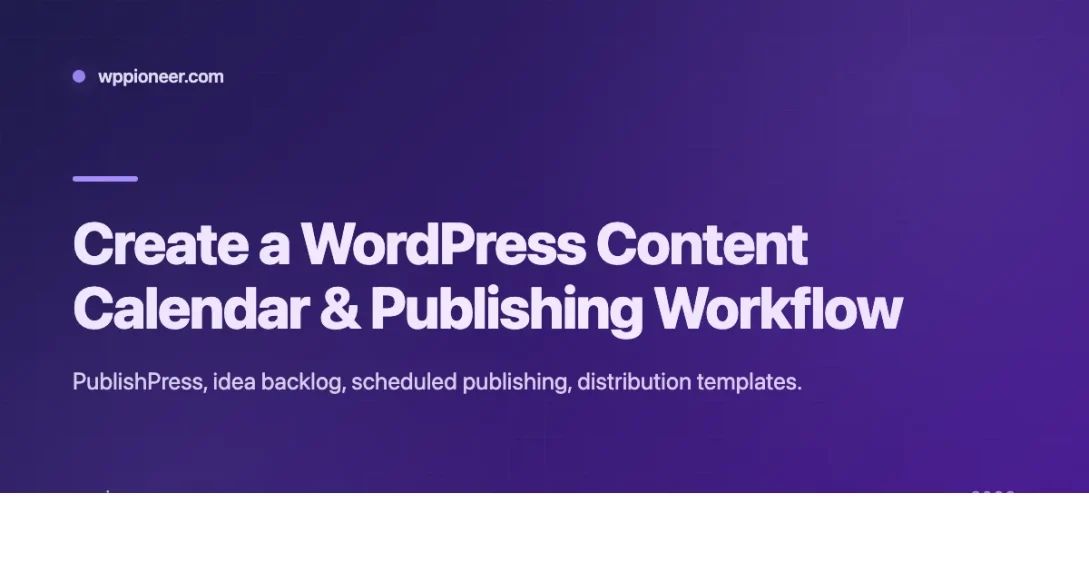
A content calendar is not a Google Sheet with dates on it
A content calendar is the intersection of three systems: what you are going to publish, who is working on it right now, and what the publishing gate looks like before it goes live. Most WordPress sites have the first one, the planning sheet, and skip the other two entirely. Which is why most blogs have drafts from 2023 still sitting unpublished in them, and why the “editorial calendar” gets quietly abandoned after three months.
This guide walks through the workflow I use on a six-site operation: PublishPress on WordPress for the publishing gate, a lightweight Notion board for idea-to-draft tracking outside WordPress, and scheduled publishing plus auto-social for the distribution tail. The setup takes an afternoon to configure and genuinely saves hours per week once it is in place.
The three stages a working calendar has to cover
- Idea capture. A structured list of topics, each with primary keyword, target audience, and internal owner. This lives outside WordPress (Notion, Airtable, even a Google Doc) because not every idea will become a draft, and WordPress is not built for triage.
- Draft to ready. Work-in-progress drafts live inside WordPress using custom post statuses so the Posts screen doubles as a Kanban board. This is where PublishPress earns its place.
- Scheduled to live. Ready posts with a future
post_date, handled by WordPress’s built-in scheduler. Distribution (social, newsletter) triggers off the published event.
Conflating these stages into one giant Google Sheet is the most common cause of calendar collapse. Separate the ideation tool from the production tool and the sheet stops being a to-do list that creates guilt and starts being a backlog you can consult.
Stage 1: the idea backlog (outside WordPress)
A minimum viable idea backlog has seven columns:
- Working title (provisional, will change when the piece is written)
- Primary keyword (from your keyword research tool)
- Intent (informational, commercial, transactional)
- Owner (who writes this)
- Status (Idea / Approved / Scheduled / Writing / Draft)
- Target publish month (not exact date, too brittle at this stage)
- Links (research sources, competitor URLs, related existing posts)
I use Notion with a database view filtered by status. Airtable works identically. Google Sheets is fine if you are the only writer. The tool does not matter nearly as much as the discipline of actually maintaining it.
The key discipline: ideas stay in this backlog until the owner has committed to writing in the next two weeks. Only then do they get converted into a WordPress draft. Drafts in WordPress with no owner are worse than ideas in Notion, because they inflate the “active work” count on the Posts screen and make the publishing funnel look healthier than it actually is.
Stage 2: WordPress custom post statuses
WordPress’s default statuses are Draft, Pending Review, Scheduled, and Published. That is enough for a solo blog with one writer. A two-or-more-person operation benefits from adding custom statuses. PublishPress adds these out of the box, and they map cleanly onto actual editorial workflow:
- Pitch. An idea that has been converted into a post shell but not written yet.
- Assigned. Writer has picked it up and is actively working.
- In progress. Writing actively in the block editor.
- Draft. First draft complete, waiting for editorial review.
- Pending review. Edited by the writer based on feedback, waiting for final approval.
- Approved. Scheduled or ready to be scheduled.
At the top of the Posts screen, group by status and you have a Kanban view of editorial flow without installing a separate Kanban plugin. PublishPress’s calendar view overlays this onto an actual calendar grid, which is where the whole system clicks into place. You can see the next two weeks of scheduled output, the gaps in coverage, and which posts are stuck in review, all on one page.
Stage 3: scheduling and automated distribution
WordPress schedules posts reliably as long as WP Cron is working. Two things to verify during setup:
DISABLE_WP_CRONis not accidentally enabled without a replacement (real server cron hittingwp-cron.phpevery 10 minutes).- Timezone in Settings and General matches your publishing team’s working timezone.
For distribution after publish, two patterns work:
Pattern A: webhook-driven social posting. Use a plugin like Blog2Social, Jetpack Social, or a no-code integration via Zapier or Make triggered by the WordPress webhook on post publish. Pro: customize per-platform captions for Twitter, LinkedIn, and Facebook separately. Con: another tool in the stack to maintain.
Pattern B: auto-post via RSS. Point Buffer or Publer at the blog’s RSS feed and let the tool consume new items. Pro: zero configuration after initial setup. Con: captions are generic and the same on every platform, which is not ideal for engagement.
For multi-site operations I prefer Pattern A on flagship posts where the social caption matters, and Pattern B on secondary posts where generic is fine. The right answer depends on how much time you want to spend on social captions per post.
PublishPress configuration in under 20 minutes
The free PublishPress Planner plugin gives you custom statuses, editorial metadata, and the calendar view. The Pro version adds notifications, reminders, and more granular permissions, which is worth the upgrade once you have more than two writers. Setup steps:
- Install PublishPress Planner from the plugin directory.
- Enable the Custom Statuses, Editorial Calendar, and Editorial Comments modules.
- Add the custom statuses listed above (or prune to your actual workflow, because fewer statuses usually beat more).
- Configure notification rules so the author knows when a draft moves to Pending Review, and the editor knows when a review is requested.
The weekly editorial cadence
What the editorial week actually looks like on a small team running two posts per week:
- Monday: review the calendar for the week. Confirm what is shipping Wednesday and Friday. Reassign anything slipping.
- Tuesday: writing day. No meetings, no review gates. Focused writing.
- Wednesday: first publish of the week plus the first editing round on Friday’s post.
- Thursday: final edit and schedule Friday’s post. Featured image and social captions locked in.
- Friday: publish, social distribution, newsletter mention.
- Friday afternoon: topic review. What is in the pipeline for next week? Pull one idea from the backlog into drafting so Monday has something to review.
This assumes two posts per week, which is a sustainable cadence for a small team producing 1,500 to 2,500 word articles. Scale up or down proportionally if your format or team size differs.
Writing workflow inside WordPress
A few conventions that pay off over time:
- Draft in the block editor, not in Google Docs. Round-trips through Google Docs introduce formatting gremlins and cost time when you paste the content in.
- Use the Outline panel in the block editor to see heading structure while writing. Catches level skips before they become accessibility problems.
- Set featured image before Review. Leaving featured images for last means they get rushed or skipped, and posts without images underperform on social.
- Set the focus keyword and meta description before submit. Rank Math or Yoast. Do it during the last edit pass, not after publish. For the accessibility-conscious publishing workflow, see my WordPress accessibility guide.
Distribution templates save real time
For every published post, a templated distribution checklist:
- Internal link from 3 older posts where relevant
- Tweet or X post with primary keyword in the first 40 characters
- LinkedIn post with a 3-line hook plus link
- Newsletter mention in the next scheduled send
- Pinterest pin if the content is visual
- Slack or Discord community post if the content fits a niche community
Keep the template in your editor’s Snippets or as a Notion template. Do not improvise per post, because improvised distribution is how distribution gets skipped on Fridays when everyone is tired.
Measuring the calendar (because what you do not measure drifts)
A calendar that does not measure output eventually drifts. Track monthly:
- Posts published vs. planned (process health)
- Average draft-to-publish time per post (workflow friction)
- Posts started and abandoned (over-ambitious planning canary)
- Organic traffic per post at 30, 60, and 90 days (content value)
The first three metrics tell you whether the system is healthy. The fourth tells you whether the system is producing the right things. Both matter, and they fail in different ways that require different fixes.
The bottom line
A working WordPress content calendar is an idea backlog outside WordPress, a publishing gate inside WordPress, and an automated distribution layer on the end. PublishPress handles the gate, Notion handles the backlog, and scheduled posts plus Zapier or Buffer handle distribution. The entire system takes an afternoon to configure and earns back hours every week thereafter. The hard part is not the tools. The hard part is the weekly discipline of using them consistently, which is where most teams fall off.
ai content generation Beginner WordPress Tips First steps after WordPress install
Last modified: April 14, 2026