
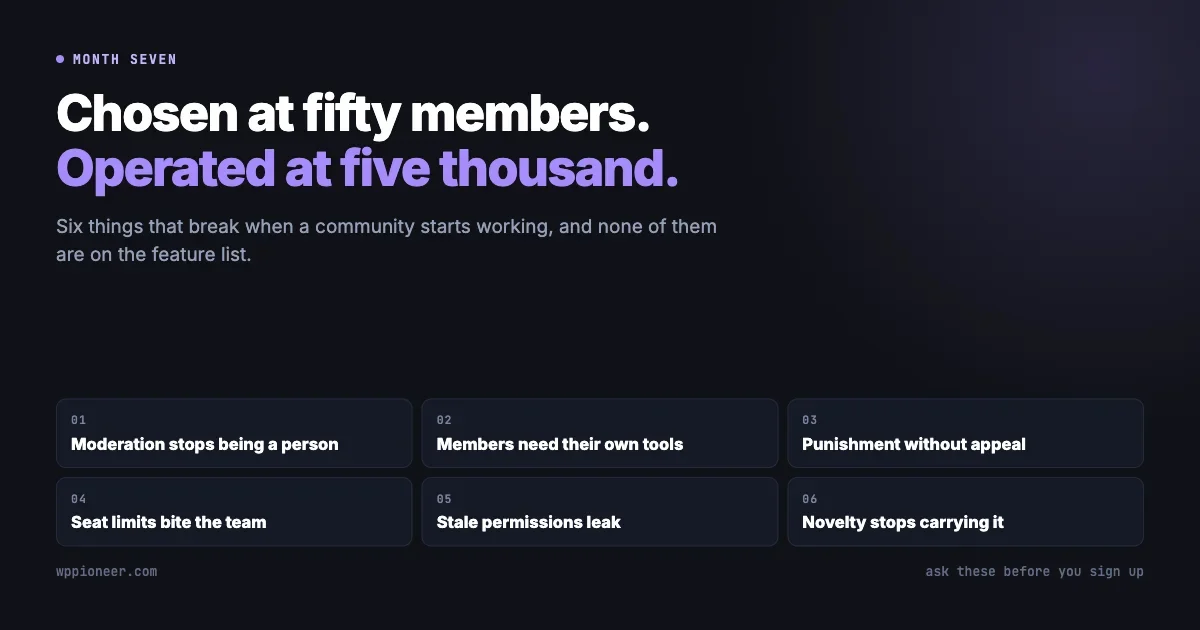
Choosing a community platform is easy while the community is small. Almost every product handles fifty engaged members well, and the differences between them look like matters of taste.
The differences become real at around month seven. Not because of a specific date, but because that is roughly when a community that is going to work starts working, and the volume arrives. What breaks at that point is rarely what people evaluated for at the start.
This is an account of the six things that actually break, and what a platform needs to have in place before they do. It is deliberately not a feature comparison, because feature lists are written for the evaluation stage and the failures happen later. The companion piece on what course platforms cost as they grow covers the commercial half of the same decision.
Break one: moderation stops being a person
In the first months, moderation is somebody reading everything. That works, it is genuinely the right approach at small scale, and it fails without warning.
The failure is arithmetic rather than effort. If the only defence is members reporting and a moderator clearing a queue, then every piece of spam, every scam link and every slur has already been live and visible before anyone acted. Volume rises, the queue grows, and the moderator is permanently behind on work that is overwhelmingly the boring kind.
What a platform needs by then is a set of checks that run before a post is ever saved. In a system built this way, the order is roughly: blocked IP address, banned words, blocked link domains, a per-minute rate limit, a duplicate-content check, and a gate on members who have not yet posted enough to be established.
The distinction that matters is what each check does when it fires, and it is worth asking a vendor about specifically.
Trigger | What should happen |
|---|---|
Banned word, blocked link, blocked IP, over rate limit | Rejected outright, with the member told why |
Duplicate content, or a brand-new member’s early posts | Publishes normally, files a report for review |
Nothing should sit invisibly in an approval queue waiting on a human. Pre-approval feels safe to owners and feels like punishment to members, and it converts a moderation problem into a latency problem that gets worse exactly when the community is growing fastest.
One implementation detail separates systems that were thought through from systems that were not. The banned-word and blocked-link checks have to run again when a member edits existing content, because otherwise editing is a trivial way around the first check. The rate limit, duplicate check and new-member gate should deliberately not run on edit, because somebody who hit the posting cap should still be able to correct a typo in something already published.
The same problem, harder, with images
Everything above concerns text, where a banned-word list does most of the work. Images and video are the version of this problem that word lists cannot touch, and they arrive the moment a community gives members somewhere to upload.
Reviewing uploads by hand does not scale past a few dozen a day, and it is unpleasant work to hand to a volunteer. The realistic answer is automated analysis on upload, checking each image against safety categories and acting on a configurable threshold.
What matters is that the action taken is graded rather than binary. A useful implementation offers at least four responses: flag for review while leaving the item published, hide it by switching its privacy to private, reject it back to draft, or delete it outright. Only the last is irreversible, and it should be reserved for cases where keeping a copy is itself the problem.
Automated analysis is also the one area where being able to choose the provider is worth having, since accuracy varies by content type and no single vendor is best at everything.
Break two: members need tools, not just moderators
The second failure is quieter and costs more, because the people it affects leave without filing a complaint.
Most conflict in a growing community is not a moderation case. It is one member finding another tiresome, overbearing or slightly unsettling. If the only options available are tolerate it or report it, most people tolerate it until they stop showing up.
What is needed is a graded set of self-protection tools that a member can use without asking anyone. Three distinct actions cover the realistic range:
- Block for harassment. Mutual and final: no interaction in either direction, direct messages prevented, and any existing follow cut.
- Mute for someone who simply posts too much. One-sided, silent, and the other person is never told.
- Restrict for the borderline case. Limits how much another person can interact with you while stopping short of a full block, and applies just as quietly.
The reason three tools matter rather than one is that members reach for the lightest action that fixes their situation. Given only a block, many will not use it at all, because it feels disproportionate to the problem and permanent in a way they are not ready for. Given a mute, they use it, stay, and the situation resolves without a moderator ever being involved.
Two operational details are worth confirming before committing to a platform. These actions should take effect immediately with no administrator approving anything, and everything a member has blocked, muted or restricted should be listed in one place in their own settings so it can be undone without hunting down the other person’s profile.
Members reach for the lightest action that fixes the problem. Offer only the heaviest one and they will choose leaving instead.
Break three: punishment without appeal costs twice
By month seven a community has suspended somebody. Frequently it has suspended somebody incorrectly, because moderators act on incomplete information, misread context, or occasionally hit the wrong member.
Most community software ships suspensions with no mechanism to dispute them. That is a design decision, and it costs on both sides of the ledger. Without an appeal route, every moderator error becomes permanent. And even when a suspension is entirely correct, a member with no way to respond feels powerless, and powerless members vent in the public feed, message the owner directly, or leave and tell people why.
A working appeals process is unglamorous and specific. The member writes their case against the particular suspension they are disputing. A moderator reads it, approves or denies, and attaches a note that becomes part of the permanent record. The member remains unable to post while suspended, but the appeal itself is unaffected by that restriction, which is the detail most home-grown implementations get wrong.
The value is not the reversals. It is that the dispute moves off the public feed into a private, recorded channel built for it, and that members can see decisions are reviewable at all. A community where decisions can be appealed reads as confident. One where they cannot reads as arbitrary, and arbitrary is the reputation that makes moderation harder every subsequent month.
Protecting the accounts that do the moderating
A related point belongs here, because it concerns the same accounts. Two-factor authentication on a community site is usually treated as an administrator feature, and that is the wrong threat model.
The accounts worth taking over are not only the ones with access to the server. They are the member who moderates the busiest space, the organiser whose account can message several thousand people at once, and the contributor whose name carries weight. A takeover there does damage a password reset does not undo, because the damage was done in the community’s own voice.
Two details decide whether an optional security feature is adopted or ignored. Nothing should be enforced until the member has entered a working code, because flipping the flag earlier locks people out of accounts they never finished securing. And enrolment should offer a scannable code rather than requiring a long key to be typed by hand. Nobody files a complaint saying a security feature was tedious to set up. They simply do not set it up, and adoption is the entire value of an opt-in protection.
Break four: the seat ceiling arrives at the worst moment
This one is commercial rather than technical, and it is worth reading the pricing page for before signing up rather than after.
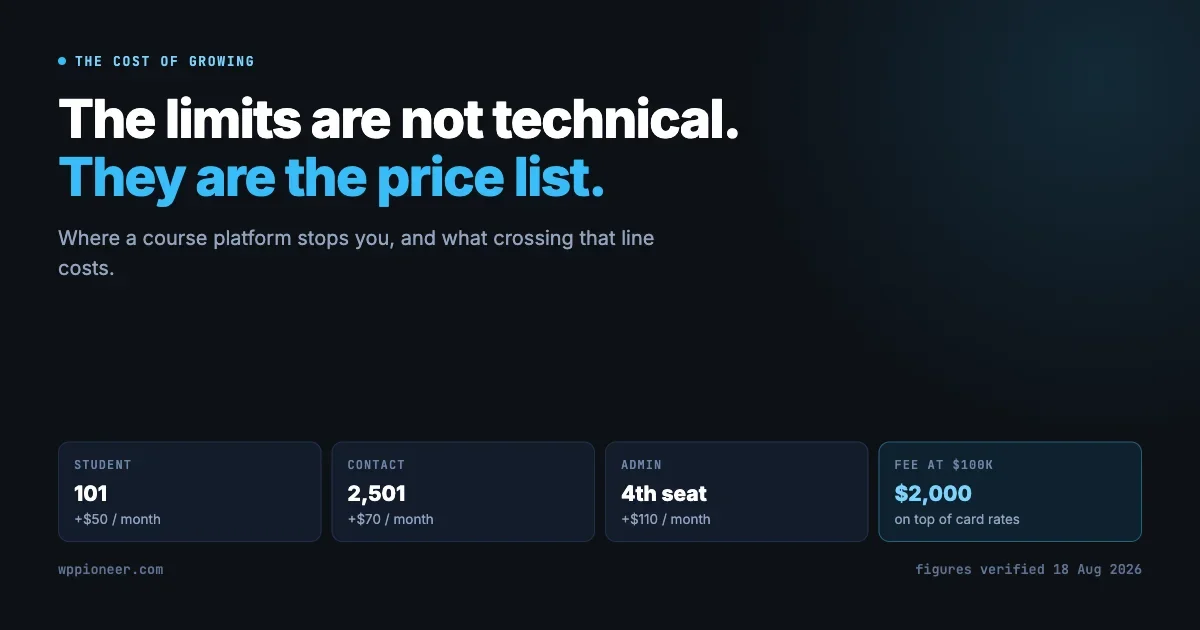
Hosted community platforms meter on different things, and the choice of what to meter tells you where the bill will land as you grow. Figures below were taken from the vendors’ own pricing pages on 18 August 2026 and should be re-checked, because they change.
Platform and plan | Monthly | What is metered | Transaction fee |
|---|---|---|---|
Circle Professional | $89 | 3 admins, 10 moderators, 20 spaces, 200GB | 2% |
Circle Business | $199 | 5 admins, 15 moderators, 30 spaces, 500GB | 1% |
Skool Hobby | $9 | Nothing capped | 10% |
Skool Pro | $99 | Nothing capped | 2.9% |
Circle offers unlimited members on every tier and meters the operating team instead. Skool caps nothing at all and takes a percentage of revenue, which at the entry tier is 10 percent.
Both approaches are defensible. The problem with metering administrators is the timing. Going from three people with dashboard access to four is not a revenue event; it usually happens because the moderation workload has become too much for three. So the cost rises at precisely the moment the operation is under strain, for a reason unconnected to income.
A volunteer moderation team is the normal shape for a community of any size, and it is the shape a seat limit penalises most directly. Ten thousand members can be free while the six people keeping them civil are the line item.
Break five: privacy computed once is privacy computed wrong
This one rarely surfaces as a complaint. It surfaces as a quiet leak that nobody notices until somebody does.
Consider a post shared with followers only in March. In April, one of those followers unfollows. If the platform decided who could see that post at the moment it was written, that person keeps access, because the answer was computed when the relationship still held. Every system that gets this wrong gets it wrong in the same direction: too permissive, invisibly, and specifically for people who used to be close to the author.
The correct behaviour is to evaluate visibility when the post is read, on every surface where it can appear: the main feed, the discovery view, search results and the post’s own permanent link. All four should run the same check against the relationship as it stands at that moment.
One further detail is worth insisting on. When a viewer is not permitted to see something, the response should be that the content was not found, rather than that access was denied. Access denied is an answer. It confirms the item exists, and in a community the existence of a conversation between two named people is frequently the sensitive part.
The same principle applies to spaces. A private space can reasonably be listed publicly with its purpose and rules visible, so that people know what they are asking to join, while its contents stay closed. A secret space should not appear anywhere at all. Collapsing those two into a single private setting is a common simplification that removes a genuinely useful middle option.
Break six: participation stops being automatic
Early communities run on novelty. Everything is new, the founder is present in every thread, and participation needs no encouragement. That ends, and when it ends the daily active count falls without anything having gone wrong.
Two mechanisms address this, and they work on different people.
Finishing what was started
Most members sign up, look around once, and never complete a profile. A completion indicator showing a percentage alongside prompts for the specific sections still empty converts an open-ended chore into a finishable goal. It should be a private nudge shown to the member about their own profile, not something other members see about each other.
The reason this matters beyond tidiness is that a directory of half-built profiles is not browsable, and a community nobody can browse loses the connections that would have kept people returning.
Rewarding the habit rather than the visit
Streak mechanics are the other half, and the implementation details determine whether they feel supportive or punitive.
A well-built streak counts consecutive days on which a member actually did something, rather than merely logged in. It calculates the day boundary using the member’s own timezone, so somebody in Tokyo and somebody in New York each get a fair midnight. And it includes a grace period, typically one day by default and adjustable, so that missing a single day does not destroy months of accumulated progress.
That grace period is the difference between a mechanic that retains people and one that loses them. A member who has built a sixty-day streak and breaks it through one busy Tuesday frequently does not start again. Milestones spaced across the first year, at intervals like seven, thirty, one hundred and three hundred and sixty-five days, give the pattern something to aim at beyond the number itself.
Two relationships, not one
There is a structural choice underneath both mechanisms that is easy to get wrong early and expensive to change later: whether member relationships are mutual, one-directional, or both.
A platform offering only mutual connections gates day-one engagement behind other people’s response times. A new member arrives, sends several requests, and then sits in front of an empty feed until strangers get around to approving them. The most motivated moment that person will ever have is spent on a screen with nothing on it.
The structure of the discussion itself is a separate decision worth making deliberately, covered in forum, Q and A board or feed. A platform offering only one-directional following removes the member’s ability to define a closer circle at all, which is the thing that makes people comfortable posting honestly.
Keeping both solves each problem separately. Following needs nobody’s permission and lets a new member build a feed worth reading in their first few minutes. Connections stay mutual and gate the things that should be mutual. Most members end up following many people and connecting with a small number, which is the correct shape and the one the software should expect.
The question the six breaks add up to
Read together, the six failures share a shape. None of them is about whether the software can host a discussion. All of them are about what happens when the number of people having discussions gets large enough that individual attention no longer scales.
That reframes the evaluation question usefully. Instead of comparing feature lists, ask a prospective platform six things:
- What runs automatically before a post is saved, and what does it do when it fires?
- What can a member do about another member without involving a moderator, and how many gradations are there?
- Can a suspended member dispute the suspension through the platform, and is that on the record?
- What is metered as the operation grows: members, administrators, storage or revenue?
- Is visibility evaluated when a post is read, and does a blocked viewer get a not-found rather than an access-denied?
- What exists to sustain participation once novelty has worn off?
Those six answers predict month seven considerably better than any feature grid.
It is worth being clear about who should ignore all of this. A community of fifty people, run by one person who reads every post, needs none of it. The tooling described here is overhead at that size, and choosing a platform on these criteria while still testing whether the community works at all is a way of spending evaluation effort on problems that may never arrive. Plenty of communities never reach month seven at all, and the ones that stall rarely stall because their moderation tooling was inadequate.
The argument for looking anyway is that the cost of being wrong is asymmetric. Choosing a platform that scales when you did not need it to costs a little money and some unused settings. Choosing one that does not, and discovering it at the point where the community finally has momentum, costs a migration at the exact moment nobody has time for one. Migrations of communities are considerably worse than migrations of content, because the thing being moved is a set of relationships and a history of who said what to whom.
What the self-hosted answer looks like
The historical weakness of running a community on your own site was never capability. It was assembly: a community plugin from one vendor, a forum from another, media handling from a third and engagement mechanics from a fourth, none of which knew the others existed.
That is the specific thing worth checking before committing, whatever products are under consideration. The question is not whether each piece works. It is whether they know about each other, and whether the presentation layer treats them as one product or as four.
For the stack behind this publication, the six breaks map onto BuddyNext for the community itself, which carries the safeguards, the block and mute and restrict tools, the appeals queue, read-time visibility and profile completion described above; Jetonomy where discussions need a forum structure rather than a feed; WB Gamification for streaks and milestones; and WPMediaVerse where members share photographs and video at volume. Both the BuddyX Pro and Reign themes ship a dedicated compatibility layer for BuddyNext, so the community surfaces are styled deliberately rather than inheriting whatever the theme happens to do.
An honest caveat belongs here. That compatibility layer exists for the community component specifically. The other pieces carry their own styling systems rather than relying on theme-side support, which is a defensible architecture and a different one, and anyone assembling this should look at the result on their chosen theme before assuming it is seamless.
Owning the stack removes the seat ceilings and the revenue percentage entirely. It adds hosting that can carry logged-in traffic, which bypasses page caching almost completely, and it adds an operations job that somebody has to do. For a community of fifty people that trade is bad. For one that has reached month seven with a volunteer moderation team and a percentage being taken off every transaction, it is usually good.
The short version
Communities are not chosen for the conditions they will operate in. They are chosen at fifty members and operated at five thousand, and the gap between those two states is where the platform decision is actually tested.
The things that break are moderation capacity, member self-protection, the absence of an appeal, seat limits that bite when the team grows rather than when revenue does, permissions that were computed once and are now stale, and participation that was running on novelty.
Every one of those is visible on a pricing page or in a feature description if you know to look for it. None of them is visible if the evaluation stops at whether the software can host a discussion, which every option can.
No comments yet