
Every course platform sells the same first impression: upload a video, set a price, start earning. That part is genuinely easy now, on every platform, and it is not where the decision lives.
The decision lives about eighteen months later, when the course is working. That is when the pricing page stops being a price and starts being a policy, and when the number that matters is not what you pay per month but what you pay to grow.
What follows is the arithmetic, taken from the vendors’ own pricing pages on 18 August 2026, and an honest account of what the alternative costs. Prices on these platforms change, so treat the figures as a snapshot and check them before making a decision.
What the hosted platforms charge
Three platforms cover most of the market a course business will consider. Kajabi and Teachable lead with courses and add community. Circle leads with community and adds courses. The bundles have converged, so the interesting differences are in the limits rather than the feature lists.
Plan | Monthly | Annual rate | Products | People | Admin seats |
|---|---|---|---|---|---|
Teachable Starter | $39 | $29/mo | 5 | 100 active students | 1 |
Teachable Builder | $89 | $69/mo | 10 | 1,000 students | 1 |
Teachable Growth | $189 | $139/mo | 50 | 5,000 students | 5 |
Kajabi Basic | $179 | $143/mo | 5 | 2,500 contacts | 2 |
Kajabi Growth | $249 | $199/mo | 50 | 25,000 contacts | 11 |
Kajabi Pro | $499 | $399/mo | Unlimited | 100,000 contacts | 26 |
Circle Professional | $89 | Not published | 20 spaces | Unlimited members | 3 admins |
Circle Business | $199 | Not published | 30 spaces | Unlimited members | 5 admins |
Read that table twice, because the second reading is the useful one. The prices are reasonable. The limits are where the business model lives.
One presentational note before going further. The annual figures are monthly-equivalent rates that require paying for a full year in advance. Teachable’s Starter plan is advertised at $29 per month on that basis but costs $348 up front, against $468 if paid monthly. The saving is real and worth taking once a business is established. It is a poor idea while still testing whether a course sells at all, because the discount is purchased with a twelve-month commitment to a platform that has not yet been proven to suit the business.
The limits are the product
Teachable Starter permits 100 active students. Kajabi Basic permits 2,500 contacts and two admin users. Circle Professional permits three admins and twenty spaces.
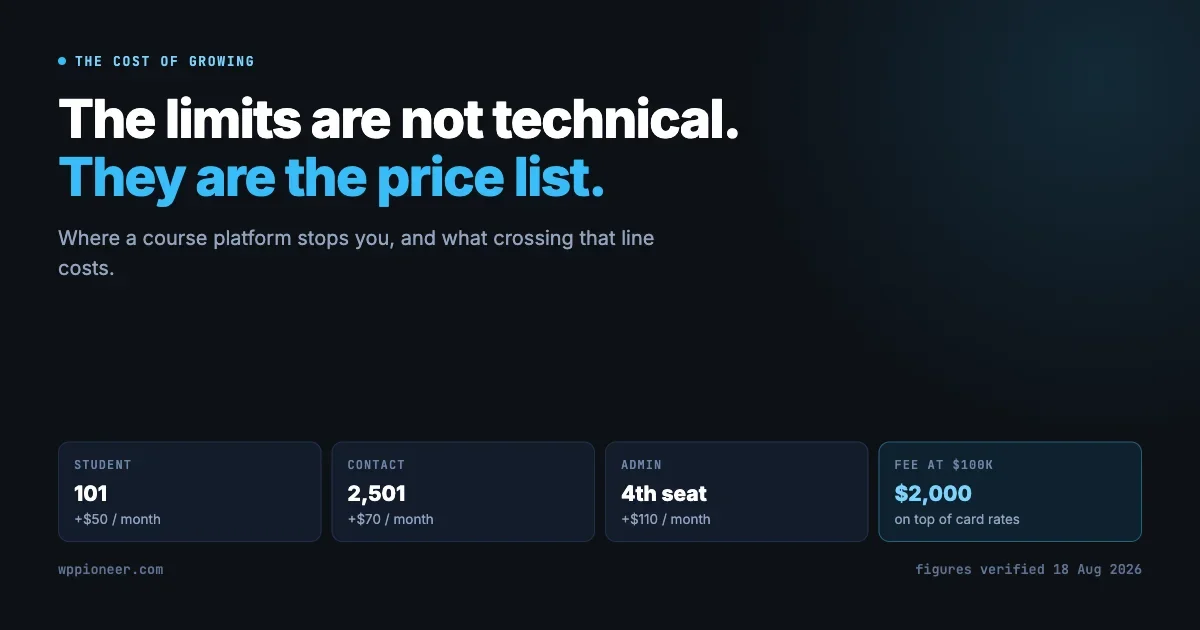
None of those numbers describes a technical boundary. Nothing about a hundred and first student costs a platform meaningfully more than the hundredth. Storing 2,501 email addresses does not strain a database built to hold millions. A third administrator does not consume infrastructure in any sense that shows up on a hosting bill.
These are pricing mechanisms, and they are placed deliberately at the points where a course business grows. That is not a criticism. It is how software as a service is meant to work, and the alignment is genuinely fair in one direction: the platform earns more when you earn more.
The consequence worth planning for is that your costs step rather than climb. A course business does not experience a gentle increase as it grows. It runs comfortably inside a tier, then crosses one number and pays substantially more the following month.
- Student 101 on Teachable Starter means moving to Builder, which is $50 more per month at list price.
- Contact 2,501 on Kajabi Basic means moving to Growth, which is $70 more per month.
- A fourth person needing admin access on Circle Professional means Business, which is $110 more per month.
The fourth administrator case deserves a moment. Growing from three to four people with dashboard access is not a revenue event. It is usually the opposite: it happens because the workload has become too much for three. So the cost rises at precisely the moment the business is under strain, and it rises for a reason unconnected to how much money is coming in.
Check what the counted unit actually means
Two platforms can both advertise a limit of 2,500 and mean entirely different things. The unit being counted matters more than the number attached to it, and the definitions are not standardised across the market.
Kajabi counts contacts. That is an email marketing unit, not a customer unit. Anyone who downloads a free guide, joins a waiting list or subscribes to a newsletter consumes the allowance in the same way a paying student does. A business running lead magnets can approach a contact ceiling while its paying enrolment remains small, which means the bill rises in response to marketing activity rather than revenue.
Teachable counts active students, which is closer to a customer unit and behaves more predictably. Circle counts neither, offering unlimited members on every tier and instead metering administrators, spaces and storage.
Circle’s approach is the most honest of the three in one specific respect: it does not charge more because an audience grew. It charges more because a team grew or an operation became more complex. Whether that suits a given business depends on whether its constraint is audience size or team size.
The limit that applies before you even start
One figure in Teachable’s published limits deserves separate attention, because it is easy to miss and it affects anyone arriving from somewhere else.
Plan | Active students permitted | Imported students permitted |
|---|---|---|
Starter | 100 | 5 |
Builder | 1,000 | 50 |
Growth | 5,000 | 1,000 |
Imported students are counted separately from active ones, and the allowance is dramatically smaller. The Starter plan permits one hundred active students but only five imported. The Builder plan permits a thousand active but only fifty imported.
The practical effect is that an existing course business with four hundred students cannot arrive on the entry tiers at all, regardless of whether four hundred students would otherwise fit. Migration in is metered independently of capacity.
There are legitimate reasons a platform might do this, including preventing abuse of low tiers by large operations. The reason it is worth knowing is simpler: the cost of moving to a platform is not only the subscription you compare on the pricing page. It can be a forced tier upgrade on day one, before the business has earned anything on the new system.
The percentage that compounds
Subscription pricing is the visible cost. Transaction fees are the one that grows without anyone deciding to spend more.
Plan | Platform transaction fee |
|---|---|
Teachable Starter | 7.5% |
Teachable Builder and above | 0% when using their payment gateway |
Kajabi Starter | 5% on third-party payments |
Kajabi Basic | 2% on third-party payments |
Kajabi Growth | 1% on third-party payments |
Kajabi Pro | 0.5% on third-party payments |
Circle Professional | 2% |
Circle Business | 1% |
One clarification is essential to keep this comparison fair. Every figure above sits on top of ordinary card processing. Kajabi’s published card rates run from 2.9% plus 30 cents down to 2.7% plus 30 cents depending on tier. Teachable quotes 2.9% plus 30 cents for United States cards and 3.9% plus 30 cents for international ones. Card processing is unavoidable everywhere, including on a self-hosted site. The platform fee is the part that is a choice.
Applied to real revenue, the arithmetic becomes concrete.
Annual course revenue | Circle Professional at 2% | Teachable Starter at 7.5% |
|---|---|---|
$25,000 | $500 | $1,875 |
$50,000 | $1,000 | $3,750 |
$100,000 | $2,000 | $7,500 |
$250,000 | $5,000 | $18,750 |
Those columns are additional to the subscription and additional to card processing. At $100,000 of sales, a business on Circle Professional pays roughly $1,068 in subscription and a further $2,000 in platform fees. At the same revenue on Teachable Starter, the fee alone is $7,500, which is why nobody stays on Starter once a course sells; the tier is designed to push you upward, and moving up is the correct decision.
What the alternative costs
Running the same operation on your own WordPress installation changes the shape of the bill rather than simply reducing it. Some costs disappear. Others appear that the hosted platforms were quietly absorbing.
Taking Learnomy as the example, because it is the stack this publication knows best: the free version carries unlimited courses, unlimited students and unlimited transactions, with Stripe and PayPal checkout, membership plans, coupons, certificates, quizzes and instructor commissions. The paid tiers are $149 per year for one site, $249 per year for up to five, and $399 per year for unlimited sites, and they add cohorts, learning paths, content drip, advanced quizzes, analytics, Stripe Connect payouts and the standards a formal training provider needs.
There is no per-student limit, no contact ceiling, no administrator seat count and no platform transaction fee. Card processing still applies, because Stripe and PayPal charge the same rates regardless of what software sits in front of them.
Set against the earlier figures, one comparison stands out. At $100,000 of annual sales, the 2% platform fee on Circle Professional comes to $2,000. The unlimited-site tier of a self-hosted course plugin costs $399 for the year. The fee alone is five times the entire licence.
That comparison is real, and it is also incomplete. Here is the rest of it.
The costs that move to your side of the ledger
Video
This is the expense most self-hosting comparisons omit, and it is the largest one. Teachable includes up to one terabyte of video storage on every tier. That storage, and more importantly the delivery bandwidth behind it, is a genuine cost the platform is carrying.
Serving course video from your own web server is a mistake regardless of budget. Video delivery has different requirements from web pages, and a shared hosting account will fail under a dozen simultaneous viewers. A self-hosted course business needs a dedicated video host, and that is a recurring bill nobody should pretend away.
Hosting
A course site is not a brochure site. Logged-in students bypass page caching almost entirely, which means the server does real work for every request rather than serving a stored copy. Hosting that can carry that load is not the cheapest tier available, and buying the cheapest tier is the most common way a self-hosted course site fails on launch day.
Your time
This is the honest centre of the whole question, and it is where most comparisons published by software vendors quietly stop.
When you own the installation, you own the operations. That means updates and the testing that should precede them, backups and the restores that prove the backups work, security patching, a staging copy for anything risky, compatibility checking when a plugin or PHP version changes, and uptime monitoring. It also means that when something breaks at an inconvenient hour, the person who fixes it is you or someone you pay.
A hosted platform sells you out of that job entirely. That is the actual product. The courses and the community are the visible part; the invisible part is that no one on Teachable has ever had to think about a PHP version.
The hosted platforms are not selling software. They are selling the absence of an operations job.
Priced honestly, that job is worth real money. A few hours a month of competent maintenance, valued at any reasonable rate, comfortably exceeds a $39 subscription. For a single instructor with one course and no technical help, the hosted platform is not merely acceptable. It is the correct answer, and anyone claiming otherwise is selling something.
Who owns the enrolment record
Cost is the argument everyone runs first. It is not the one that matters most.
A course business accumulates three assets. The course content, which is yours and portable. The member list, which most platforms will export. And the enrolment record: who bought what, when, at what price, how far they progressed, what they completed, and what credential was issued as a result.
The third asset is the one that decides whether you can ever leave. Content moves easily. A list of email addresses moves easily. Years of progress and completion history, tied to purchases and certificates, frequently does not move at all in any form the next system can use.
The practical test is a single question, and it is worth asking before signing up rather than after: if this business needs to move in three years, what specifically comes with it, and in what format?
- Can enrolments be exported with their dates, prices and progress state, or only as a list of names?
- Do issued certificates remain verifiable after the platform subscription lapses?
- Does the export include which lessons each student completed, or only whether a course was marked complete?
- Are past transactions retrievable in a form an accountant would accept?
Certificates deserve particular attention for anyone issuing a credential that means something. The same question applies to everything else a course site accumulates, which is worth thinking about alongside what your site is quietly keeping about your members. A certificate is a claim your organisation makes about a learner, and if its verification page lives on a platform you stopped paying for, the claim quietly stops being checkable. Professional bodies and employers do check, sometimes years later.
A decision rule
Reduced to something usable, the choice resolves along three lines rather than one.
- Choose hosted when the operations job is the binding constraint. One or two courses, a few hundred students, no technical person available, and time better spent teaching than maintaining. The subscription is cheaper than the alternative and the alternative is not really available to you.
- Reconsider when the percentage outgrows the licence. The crossover is not a fixed revenue figure, but the shape is consistent: once platform fees on your annual sales run to several multiples of what owned software would cost outright, the arithmetic has changed, and it changes further every year the business grows.
- Choose owned when the record itself is the asset. Formal credentials that must stay verifiable, corporate or compliance training where completion evidence has to survive an audit, or any programme where the enrolment history is the thing of value. This applies regardless of size, including to small operations.
The third case is the one most often decided too late. A business starts on a hosted platform for entirely sound reasons, and discovers three years later that the thing it most needs to keep is the thing that will not move.
The rule applied to three real situations
An independent instructor with one course and 80 students. Annual revenue somewhere under $20,000, no technical help, and every hour spent on infrastructure is an hour not spent teaching or selling. A hosted entry plan costs a few hundred dollars a year and removes a job this person cannot do. Self-hosting here would be a mistake even though the software licence would be cheaper, because the licence is not the cost that matters at this size.
An established academy with 3,000 students and a small team. Revenue at six figures, four or five people needing access, several courses running, and a percentage now being taken on every sale. This business is paying for tiers on multiple axes at once: enough seats for the team, enough capacity for the audience, and a fee on the revenue. It also has enough scale to justify paying somebody competent to maintain a site. This is where the arithmetic genuinely flips, and where the operations job stops being an obstacle because it becomes somebody’s defined responsibility rather than the founder’s evening.
A professional body issuing 200 certificates a year. Revenue may be modest and the student count small, so the cost argument barely registers. The deciding factor is entirely different: a licensing board or an employer may verify one of these credentials in 2032, and the verification page has to still exist and still say the right thing. That requirement outranks convenience, and it points to owning the record irrespective of scale.
Note that the middle case is the only one where cost is the deciding factor. The first is decided by available labour and the third by institutional obligation. Anyone choosing a platform purely on a price comparison is answering a question that only applies to one business in three.
What the owned version looks like in practice
The historical weakness of the self-hosted answer was never capability. It was assembly. A course plugin from one vendor, a community plugin from another, a forum from a third and an events plugin from a fourth, none of which knew the others existed, presented behind a theme that styled each of them slightly differently.
That is the part worth checking carefully before committing, whichever products you evaluate. The question to ask of any combination is not whether each piece works, but whether they know about each other.
For the stack this publication uses, a few of those connections are concrete rather than aspirational. Course discussions can be attached to Learnomy cohorts and to community spaces through Jetonomy, though the prior question of whether a forum, a Q and A board or a feed suits the audience matters more than which plugin provides it, and it is governed by a single community setting rather than configured separately in each place. A discussion space can be gated on a BuddyNext Pro membership tier, so access follows the membership rather than requiring a parallel list. A cohort can have a community of its own, separate from the course it belongs to. Both the BuddyX Pro and Reign themes carry a dedicated BuddyNext compatibility layer, so the community surfaces are styled deliberately rather than inheriting whatever the theme happens to do.
The pieces map onto the hosted bundle directly enough: Learnomy for courses and certificates, BuddyNext for the community, Jetonomy for discussions, Eventonomy for the live sessions, on BuddyX Pro or Reign. Whether assembling that is worth doing depends entirely on the three-part rule above, and for a large number of readers the honest answer will be no.
The summary worth keeping
Hosted course platforms are priced fairly for what they do, and what they do is remove an operations job that has genuine value. Their limits are not technical constraints but commercial ones, positioned at the points where a course business grows, which means costs step upward at predictable thresholds rather than rising smoothly.
Transaction percentages are the cost that compounds without a decision being made, and at six-figure revenue they routinely exceed what owned software costs outright by several multiples.
Owning the stack removes the ceilings and the percentages, and adds video hosting, capable server hosting and an operations job that has to be done by someone. For a single instructor, that trade is usually bad. For a business whose enrolment record is an asset it will need in ten years, it is usually good.
The question that settles it is not what a platform charges this month. It is what leaving costs, and whether the record of who learned what comes with you when you go.
No comments yet