Forum, Q&A, Idea Board or Feed? Pick the Wrong One and People Stop Posting

If you are adding discussions to a WordPress site, there is a decision most people skip: what shape should the conversation be?
Almost everyone defaults to a forum, because forums are what we all grew up with. Sometimes that is right. Often it is the reason a community goes quiet after three weeks, because the shape of the software does not match the shape of the conversation people actually wanted to have.
There are four common formats. Here is what each is for, how to tell which one you need, and what happens when you get it wrong.
The four formats
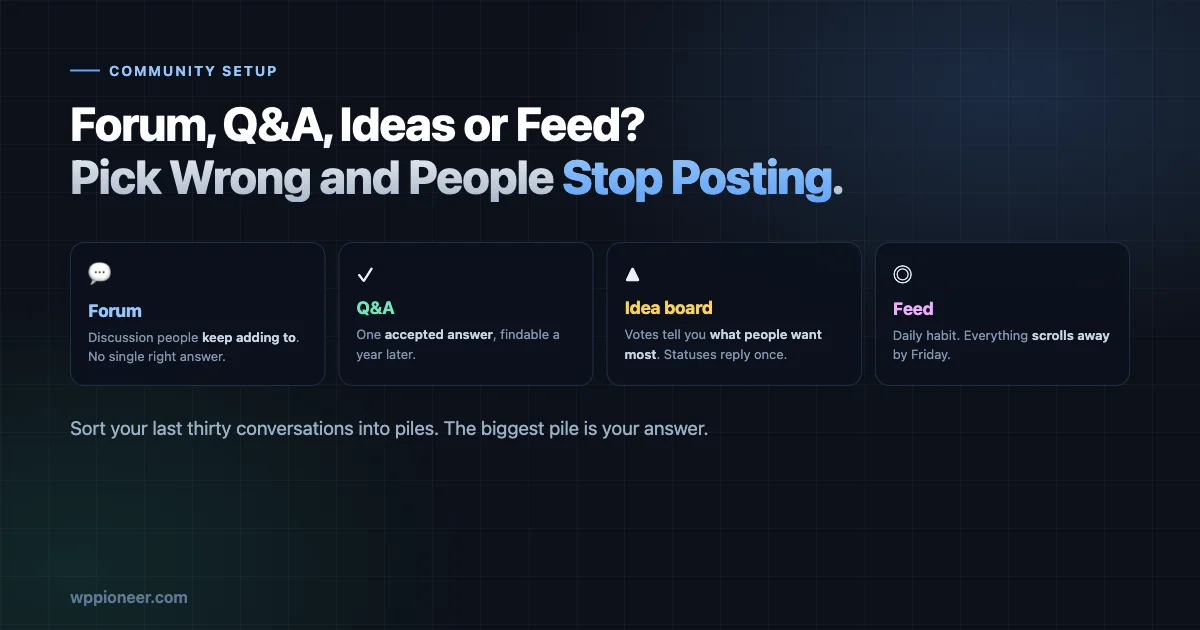
Forum. Threaded topics in categories, sorted by recent activity. Somebody starts a topic, people reply, replies nest under each other. The classic shape.
Q&A. A question, multiple answers, and one answer the asker marks as accepted, which floats to the top. Stack Overflow’s shape.
Idea board. Members post suggestions, other members vote, and each idea carries a status – under review, planned, shipped, declined. A public roadmap that your users write.
Activity feed. A stream of short posts in reverse chronological order, with reactions and comments. The social shape.
They look interchangeable. They are not, and the difference is what the conversation is for.
Match the format to the job
The test is simple: what does a good outcome look like?
| If a good outcome is… | Use |
|---|---|
| A discussion people keep adding to | Forum |
| One correct answer, findable later | Q&A |
| Knowing what your users want most | Idea board |
| People coming back daily | Feed |
Work through those honestly and the answer is usually obvious.
Support requests want Q&A. Someone has a problem with one right answer. In a forum, that answer ends up buried in reply fourteen, and the next forty people with the same problem never find it. Q&A puts the accepted answer at the top permanently. That single difference is the whole reason support communities that use forums keep answering the same question forever.
Feature requests want an idea board. In a forum you get forty separate topics each asking for something, no way to tell which matters most, and no way to tell people you heard them. Votes give you priority order from your users rather than from whoever emailed loudest. Statuses give you a way to say “planned” or “declined” once, publicly, instead of in forty replies.
Open-ended conversation wants a forum. Discussions with no single answer, where the value is in the back-and-forth. Book clubs, strategy debates, “how does everyone handle X”. Q&A actively hurts here, because marking one answer accepted implies the others were wrong when they were just different.
Daily habit wants a feed. If you want people opening the site out of habit, short posts and reactions do that. A forum does not – forums are somewhere you go when you have a question, not somewhere you check.
What going wrong looks like
The failure is rarely dramatic. It is quiet, and it looks like the community “just not taking off”.
Support in a forum. Same question asked repeatedly, because previous answers are unfindable. Your team answers the same thing weekly. Members conclude nobody has asked before and post again. The archive grows without becoming useful.
Feature requests in a forum. You cannot tell what people want most, only what got replied to most – which is a measure of controversy, not demand. Meanwhile nobody knows whether you read any of it.
Casual chat in Q&A. Nothing gets marked as accepted because there is no correct answer. Every thread looks unresolved. People stop posting because the format keeps implying they failed.
Everything in a feed. Great for week one, terrible by month three. A question asked on Tuesday is unfindable by Friday. Useful conversations scroll away permanently.
That last one is worth dwelling on, because a feed feels like the modern choice and it is the easiest to get wrong. Feeds are optimised for recency. Anything worth keeping needs somewhere else to live.
Most communities need more than one
Here is the part that catches people: the answer is usually not one format.
A typical product community wants all of:
- A Q&A space for support, so answers accumulate and stay findable
- An idea board for feature requests, so priority comes from votes
- A forum for general discussion that has no right answer
- Possibly a feed for announcements and lighter chat
Which is why we built Jetonomy with all four in one plugin rather than picking one. Spaces sharing the same members, the same voting, the same search and the same moderation – so a member does not have four logins, and you do not moderate four systems.
The practical benefit is not the feature list. It is that you can change your mind. Start with a forum, notice support questions are drowning, and add a Q&A space without migrating anything or asking members to learn a second product.
How to decide, in ten minutes
Look at where your conversations happen now – email, a Facebook group, a Slack channel, your inbox – and sort the last thirty into three piles:
Pile one: questions with an answer. “How do I do X?” Someone knows, you say it, it is done. → Q&A
Pile two: requests. “It would be good if it did Y.” No answer, just a want. → Idea board
Pile three: everything else. Opinions, experiences, discussion. → Forum or feed
Whichever pile is biggest tells you what to launch first. The other piles tell you what to add next.
If the piles are close in size, you need more than one format, and you should plan for that from the start rather than discovering it later.
A worked example
Take a small software product with about 400 customers. The founder currently answers everything by email and wants to move it somewhere public.
Sorting the last thirty conversations gives roughly:
| Type | Count | Format |
|---|---|---|
| “How do I…” with a definite answer | 17 | Q&A |
| “Could it also do…” | 8 | Idea board |
| General discussion, opinions, showing work | 5 | Forum |
Seventeen of thirty are support questions with one right answer. So the first space is Q&A, not a forum – and that single decision means that a year from now the twenty most common questions have accepted answers sitting at the top, and the founder has stopped answering them personally.
The idea board goes in at the same time, because eight requests is enough to need prioritising and because it gives customers somewhere to put the “could it also” messages that would otherwise clutter the support space.
The general forum waits. Five conversations is not enough to fill a space, and an empty space is worse than no space. It opens when the Q&A space is busy enough that off-topic discussion starts appearing in it – which is the natural signal that a separate home is needed.
That sequence generalises: lead with the format that matches your biggest pile, add the second when a real need appears, and let the third wait until something is actively spilling over.
Three mistakes worth avoiding
Starting with too many spaces. Six empty spaces look abandoned. Two spaces with real conversation look alive. Start with one or two and split when a space gets genuinely busy – the split is easy, the recovery from looking dead is not.
Choosing based on what you like reading. You are not the target user. You already know the answers. Sort the piles.
Assuming a forum is the safe default. It is the familiar default. If most of your conversations are support questions, a forum is the expensive choice, because you will answer the same thing forever and never build a knowledge base.
What each format needs from you
Worth knowing before you commit, because the formats do not cost the same to run.
Q&A is the lowest ongoing effort once it has content. Answers accumulate, the good ones stay at the top, and the archive gets more useful over time rather than less. The cost is upfront: somebody has to answer questions properly and mark accepted answers, or it degrades into a forum with extra steps.
An idea board is almost no effort, and one obligation. You have to update statuses. An idea board where everything sits at “under review” for a year is worse than not having one, because you have visibly asked for input and visibly ignored it. Ten minutes a month is enough – moving a few items to planned or declined.
A forum needs the most attention. Open discussion needs somebody to keep it going in the early weeks, or it stalls. Expect to seed conversations yourself for a month or two.
A feed needs the most and gives the least durable value. Daily posting to keep it alive, and the content scrolls away. Worth it only if daily return visits are genuinely the goal.
If you have very little time, that ordering matters more than the format-matching exercise above. Q&A and an idea board can be run by one person in an hour a week. A busy forum cannot.
What this connects to
Format is one decision among several. Two others matter about as much.
Who can see what. A discussion space that is open to everyone behaves differently from one gated behind membership. Our guide on what a WordPress plugin can access covers the trust side of adding any community plugin to your site.
What happens when it grows. Every format gets slower as it fills up, and some implementations handle that far better than others – which is worth checking before you have ten thousand topics rather than after.
Who moderates, and when. Every format needs someone reading it. Q&A needs answers marked accepted or the archive never becomes useful. Idea boards need statuses updated. Forums need off-topic threads moved before the space loses its shape. This is the cost people forget when they add a community to a site, and it is the reason communities more often die of neglect than of the wrong software. Budget an hour a week before you launch, not after.
If you are still choosing which plugin to run any of this on, our roundup of essential WordPress plugins for beginners covers the wider principle that applies here too – a small deliberate set beats a big pile, and every plugin you add is a decision you are responsible for.
But the format decision comes first, because it is the one you cannot easily undo once people have posted. Moving a hundred forum threads into a Q&A structure means deciding, retrospectively, which reply was the answer. Nobody does that. The threads just stay in the wrong shape.
The short version
Pick the format by what a good outcome looks like, not by what you have seen before.
Questions with answers want Q&A. Requests want votes and statuses. Open discussion wants a forum. Daily habit wants a feed.
And if the honest answer is “we need two of those” – which it usually is – choose a setup that gives you both without running two products, because the alternative is asking your members to keep track of where things live. They will not, and that is how communities go quiet.
Ten minutes sorting your last thirty conversations will tell you more than a week of comparing feature tables.